Ruochen Zhang
Abstract
This study applies Ernst Bloch’s philosophical concepts, focusing on concrete, abstract utopia, and the Not-Yet-Conscious to analyze the social value of Mondrian’s Neoplasticism paintings. It first analyzes Bloch’s Key concepts from the principle of hope, mainly discussed from utopian and aesthetic thought. Then the discussion turns to Mondrian’s art under the social context and a deep analysis of his Neoplasticism style. Finally, the paper used the philosophical ideas of Ernst Bloch to explain Mondrian’s art from three different perspectives. The study concludes that Mondrian’s art embodies Bloch’s notion of concrete utopia, offering an anticipatory vision that influences society across various domains.
Keywords: Piet Mondrian, Ernst Bloch, The Principle of Hope, Social Value
1. Introduction
1.1 Background and Purpose
In modern art, political meaning increasingly intersects with aesthetic innovation. They no longer only serve for religious or naturalistic functions. Instead, modern art evolves into an art form that tries to break the past and tries to find a way to influence society. Piet Mondrian stands out as a figure whose abstract composition showcases both artistic purity and social vision.
This study applies Ernst Bloch’s philosophy to interpret Mondrian’s work for two main reasons.
First, both Bloch and Mondrian deeply believe in the function of art in changing society. Second, Bloch and Mondrian have similar background, their statement both try to find a utopia that help them escape from War trauma.
1.2 Current Research
Bloch’s “The Principle of Hope” is largely used to interpret art, especially in performance and music.
Mondrian believed deeply in his artwork in changing the world to a fairer and more peaceful society. However, it remains controversial whether his work genuinely carries a political purpose. Recognizing Ernst Bloch’s emphasis on the role of art and utopian imagination in shaping
society, this study seeks to evaluate that question.
1.3 Research Innovation
By combining philosophy and history of art, this study aims to interpret art in a cross-disciplinary perspective.
Not many studies have focused on the utopian perspective of Mondrian’s paintings’ societal meaning.
2. Theoretical Framework: Ernst Bloch’s Philosophy
2.1 Historical Context of Utopian Thought
Before Ernst Bloch, the concept of Utopian could trace back to Plato where he first depict an ideal society in the work The Republic; later, Thomas More coins the actual term “utopia and establishes the genera of utopian literature; during the enlightenment, lots of thinkers pushes this concept by believing reason and science could lead to a perfect society; in the Communist Manifesto Karl Marx states a utopian society where alienation is overcome; finally leads to Ernst Bloch, who is a German Marxist philosopher.
2.2 Concrete vs Abstract Utopia
Bloch refers to concrete utopia as a utopia that arises from historical contradictions, points toward historical paths for change, and awakens longing for transformation. Abstract utopia is the opposite of concrete utopia; it offers a passive escapism, and it is an invocation of a general normative ideal.
2.3 The Not-Yet-Conscious
The Not Yet Become is a state that exists in the inherent of the world but has not yet been realized. The process of realizing the not yet, and then exploring as part of the present, is what Bloch referred to as an “utopian function”. The Not Yet has a positive function in developing society into a better future.
2.4 Art as Prefiguration of Possible Worlds
Ernest Bloch believes in the power of art to present the Not Yet to the audience. Art has the function of depicting a society that does not yet exist, and the property of art helps the audience to be immersed in that imaginary world. By doing so, art allows people to realize the not yet and see what could be possible. Thus, Bloch believes that art functions as a “laboratory” in testing utopian possibilities.
3. Piet Mondrian
3.1 Biographical Background
Starting as a realist, Mondrian’s style changed constantly along with the place he was in. In his early time in the Netherlands, he stuck to a naturalistic and impressionistic art style. Later, he moved back and forth between the Netherlands and Paris a few times. During that period, he was largely influenced by World War I, the Theosophical Society, and Cubist artworks. These factors all contribute to his revolution towards abstraction. Eventually, he founded, along with Bart van Der Leck and Theo van Doesburg, the “De Stijl”. Starting from there, his art became a way for him to search for a purely abstract form. Later years in Mondrian’s life, he moved to New York, where he fell in love with music and dance, and created classic works including “Boogie Woogie”.
3.2 Mondrian’s Abstract Visual Language.
Mondrian sought artworks that only include basic elements in art, including “Black lines and three primary colors”. This classical style of his was a means to seek a balanced composition. He wrote in one of his letters to H. P. Bremmer in 1914
“I construct lines and color combinations on a flat surface, in order to express general beauty with the utmost awareness. Nature (or, that which I see) inspires me, puts me, as with any painter, in an emotional state so that an urge comes about to make something, but I want to come as close as possible to the truth and abstract everything from that, until I reach the foundation (still just an external foundation!) of things… I believe it is possible that, through horizontal and vertical lines constructed with awareness, but not with calculation, led by high intuition, and brought to harmony and rhythm, these basic forms of beauty, supplemented, if necessary, by other direct lines or curves, can become a work of art, as strong as it is true.”
From an aesthetic perspective, he aimed to depart from the traditional mimicking of nature, such as that of Plato’s theory; at the same time, his style was still on the track of Western aesthetic beauty rules. By balancing basic abstract geometric elements, he is discussing the very source of the meaning of aesthetic beauty.
He not only believes in the beauty and the seeking of the foundation of nature in his art, mostly he also believes in the power of art to make a harmonious society. He believed that since it was possible that contradictory lines could reach balance, so can the opposite forces in the real to reach equality.
3.3 Analysis of Key Works
3.3.1 Composition with Red, Blue, and Yellow (c. 1930)
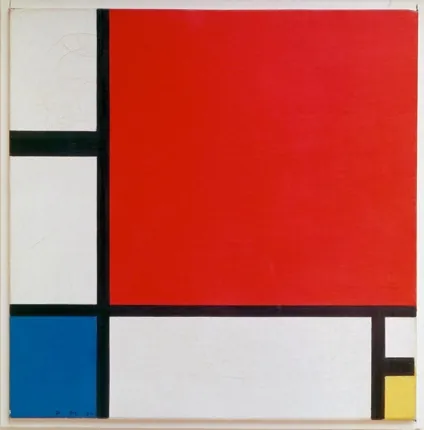
In the work Composition with red, blue and yellow (figure 1), one of the most purely abstract works that he created in the Netherlands just after World War I. The Netherlands was in a bad shape, and he was prevented from traveling back to France. In this work, we can see his urge to find balance and escape from the war through his composition. The canvas includes a red grid on the upper right and a blue grid diagonal to the red at the left corner, as if it is there to balance the huge red grids. And then there is this tiny yellow block in the left corner. Perhaps influenced by the environment and the war, he consciously put red (which refers to anger and madness) and blue (which refers to sorrow and nostalgia) in most of the plan. Other than colors, Mondrian also played a lot with the black lines: he designed the lines in different widths and lengths (some reach the ends of the canvas, others do not). All these subtle changes within the elements, together, create a sense of balance and harmony; all the intersecting points and the vibrant color between lines create a sense of order, a feeling of an ideal life in Mondrian’s mind.
3.3.2 Broadway Boogie Woogie (1942–43)
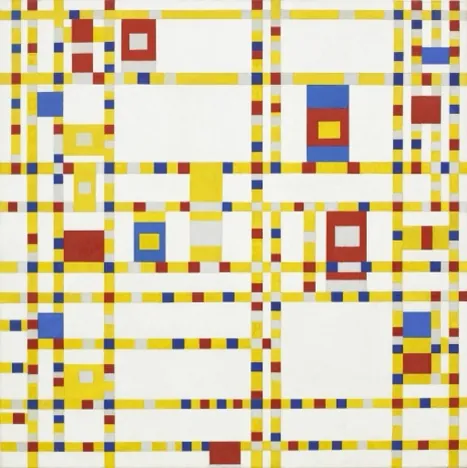
Another work created later in Mondrian’s life, the Broadway Boogie Woogie (figure 2), shows how Mondrian went one step closer to his Utopian ideal. He moved from the Netherlands to New York to move away from the fascists. The environmental difference had changed Mondrian’s style from the simple, basic lines to a more complex, vibrant abstract form. It is obvious that he started to use more yellow color and smaller grids. This artwork proves how he was trying to depict society with geometric elements, and consists of the theme of the ideal, the utopian sides of the city he was in. The elements might be influenced by the busy street view in New York, or the classic jazz music “Boogie Woogie” that Mondrian was fond of. In either way, they were both moving and changing objects in real life, and Mondrian changed that real-life objects into his visual language in this static painting. By doing so, he created this dynamic equilibrium, which further contributes to that sense of harmony in his work.
4. Analyzing Mondrian’s artworks under Bloch’s theory
4.1 Visualizing the Utopian society
Mondrian’s artworks showcase how the Not Yet exists in art forms. By drawing a visualized ideal society, where contradictory lines reach balance through composition, he succeeds at immersing viewers into a utopian world, where they could find hope and harmony. His purely abstract form, different from naturalistic paintings, leaves room for viewers to imagine and think beyond the current reality.
Mondrian’s artworks provoke viewers to think vividly about the nuances and the subtle changes, which showcase the property of his art in awakening a longing for transformation.
From Mondrian’s life experience and changes in styles, it points out that his utopian plan was inspired by real historical events (including World War I).
That’s why Mondrian’s paintings fit Bloch’s idea of concrete utopia, and function to help society to realize the possible inherent in the world.
4.2 Art as Critique and Idealization of Society
Mondrian’s extreme minimalism and abstraction work as a means to criticize materialism. It can be seen as due to the loss of hope from the war trauma, he stopped drawing nature, and tried to find a world that he believed, a “true world” that does not yet exist.
Through formalism, he used the purest art style to call for spiritual emancipation.
4.3 The Influence of Mondrian’s Art on Modern Society
Artists influenced by Mondrian invent art into the public space, such as in architecture and fashion, which extends Mondrian’s art utopian function by letting more people realize the power of art in bringing harmony and thoughts.
5. Discussion
Some studies showed how Bloch sometimes has a blurred concept between “concrete” and “abstract” utopia, hence, there is a possibility to explain that Mondrian’s art is not fully concrete. The fact that Mondrian’s art does not contain a method that is specific enough for viewers to reach the ultimate balance and harmony.
This study ultimately aims to broaden the discussion by comparing utopian artworks in Eastern cultures and investigating how the concept of utopia may evolve in the age of artificial intelligence.
6. Conclusion
The essay reveals that Mondrian’s artistic style was deeply shaped by his life journey. His moves from the Netherlands to London, and later to Manhattan, alongside the impact of World War I, influenced his transition from realistic to purely abstract, and ultimately to a more complex abstraction. Mondrian’s ideas that contradictory lines could achieve equilibrium can be interpreted by Bloch’s concept of the “not yet conscious” —the imagined ideal that inspires forward-looking hope. By depicting and imagining an idealized world, Mondrian’s work offers a form of utopian hope that can positively influence visions of future society.
However, Mondrian’s artworks align more closely with what Ernst Bloch defines as abstract utopia, which is visions of idealized harmony that lack concrete pathways toward social transformation. Nevertheless, Mondrian’s works have a profound impact on art history. From an aesthetic perspective, Mondrian’s art investigates the basic elements of art that could be traced back to Renaissance paintings. His grid-based compositions further influenced architecture and other artists.
Mondrian’s art has long been considered the key in abstract art in an aesthetic way, but has less tried to focus on the social value. This study used Ernst Bloch’s philosophical framework, along with an analysis of Piet Mondrian’s paintings, to examine the social value of Mondrian’s Neoplasticism art value. The study finds that Mondrian’s art fits into Bloch’s concept of concrete utopia, which means his art helps the society in realizing that not yet become. This is helpful in future studies of interpreting the utopia function in modern artworks, and brings a new understanding of Mondrian’s art.
References
Bloch, E. (1986). The Principle of Hope (N. Plaice, S. Plaice, & P. Knight, Trans., Vol. 1). MIT Press. (Original work published 1954)
Bloch, E. (1988). The Utopian Function of Art and Literature: Selected Essays (J. Zipes & F. Mecklenburg, Trans.). MIT Press.
Wiegand, C. (1943). The meaning of Mondrian. The Journal of Aesthetics and Art Criticism, 2(8), 62-70.
HODERMARSKY, E. (2016). Becoming Piet Mondrian: Two Transitional Works. Yale University Art Gallery Bulletin, 105–109.
SIMON, B. (2013). Mondrian’s Search for Geometric Purity: Creativity and Fixation. American Imago, 70(3), 515–555.
Marwick, Arthur (2000). "The Art of Total War". In Chickering, Roger; Förster, Stig (eds.)
Cooper, Harry (1997). Dialectics of Painting: Mondrian's Diamond Series, 1918-44 (Thesis). Harvard.