For a long time, I deeply disliked Beijing's cold, long winters. Winter brings a sense of loneliness and despair, but this feeling is so common. In works of art, for example, we can always see that people across different times and places have also struggled with suffering and sorrow. Perhaps this already proves that those who are lonely and sad are not alone. And does our struggle in winter not, in fact, prove our existence? Confronting winter makes even the faintest light in the cold feel extraordinarily warm and profound.
When looking at the following paintings, not everyone will necessarily share the same feelings. But in any case, if we could step into the pictures, we might see the artists' strength in resisting and struggling against the cold spilling beyond the frame. At the lowest points in their lives, they chose to paint rather than give everything up, still finding ways to make the world hear their voices. Perhaps this is a perfect expression of survival and resistance.
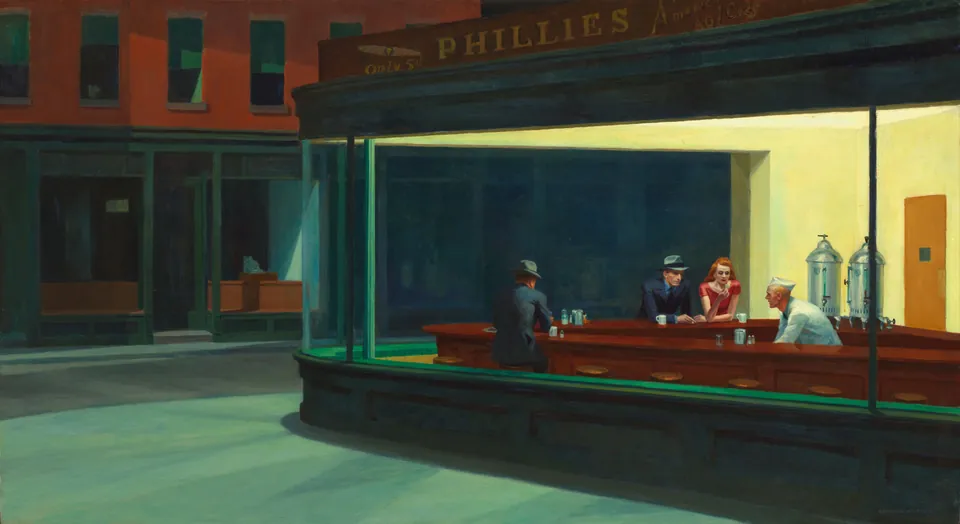
The first painting, Nighthawks, is a work by the modern artist Edward Hopper. Through his use of time and space, his works often capture the profound loneliness of urban life. Hopper himself often felt like a spectator in life. The fractured relationship between him and his wife later became an important source of motivation and inspiration for his art.
The four figures in the painting seem trapped in interwoven yellow and green light, with nowhere to escape, yet isolated from one another. It is a scene without direct communication, and silence envelops everything.
In Nighthawks, he seems to pour his loneliness and sadness onto the canvas as a way of releasing his emotions. At the same time, the painting goes beyond personal feelings to convey a universal resonance: lonely people are not truly alone. Hopper's work seems to tell people that he understands this feeling, while trying to reveal the positive meaning that might exist within loneliness. The light inside the diner, for example, contrasts sharply with the surrounding darkness. Could this symbolize hope? And perhaps those broad glass windows are windows through which we can glimpse an inner world, allowing light to fall on a world that appears lonely.
Finally, this painting looks a little like a frame from a film, encouraging viewers to imagine the stories behind its characters. The cinematic effect, combined with the familiar theme of boredom and loneliness, sometimes leads viewers to recall a moment buried deep in their memories that invites endless recollection. Hopper's art and cinema share narrative qualities, expressing a classic composition similar to a frame within a frame. He loved films, and filmmakers also liked to draw inspiration from his paintings. These influences between different art forms are always interesting to encounter.
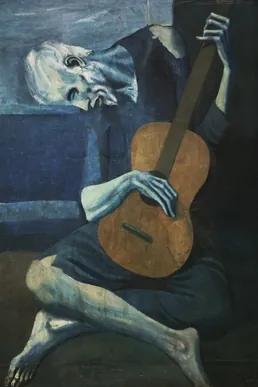
The next painting is Picasso's The Old Guitarist, one of the famous works of his Blue Period. As its name suggests, the Blue Period was a low point in Picasso's life. First, his friend Casagemas took his own life in a restaurant after his marriage proposal to the person he loved was rejected, which had a profound emotional impact on Picasso. In addition, Picasso was experiencing financial hardship and witnessing the suffering and poverty of people at the bottom of society.
A wandering musician holding a guitar forms the subject of this painting. The predominant blue and the musician's posture express melancholy and loneliness. The only warm-colored element, the brown guitar, represents the musician's sole hope for survival. When a sad person looks at this work, it is as though they see not just an unnamed musician but Picasso himself and themselves. Perhaps all three are seeking a little comfort in art amid their sadness.
Many people dislike Picasso because one of the main reasons for his later fame was his own promotion in the art market. Yet in the Blue Period, we can see many pure and authentic aspects of Picasso: his inner exploration, his vulnerability, and his struggles.
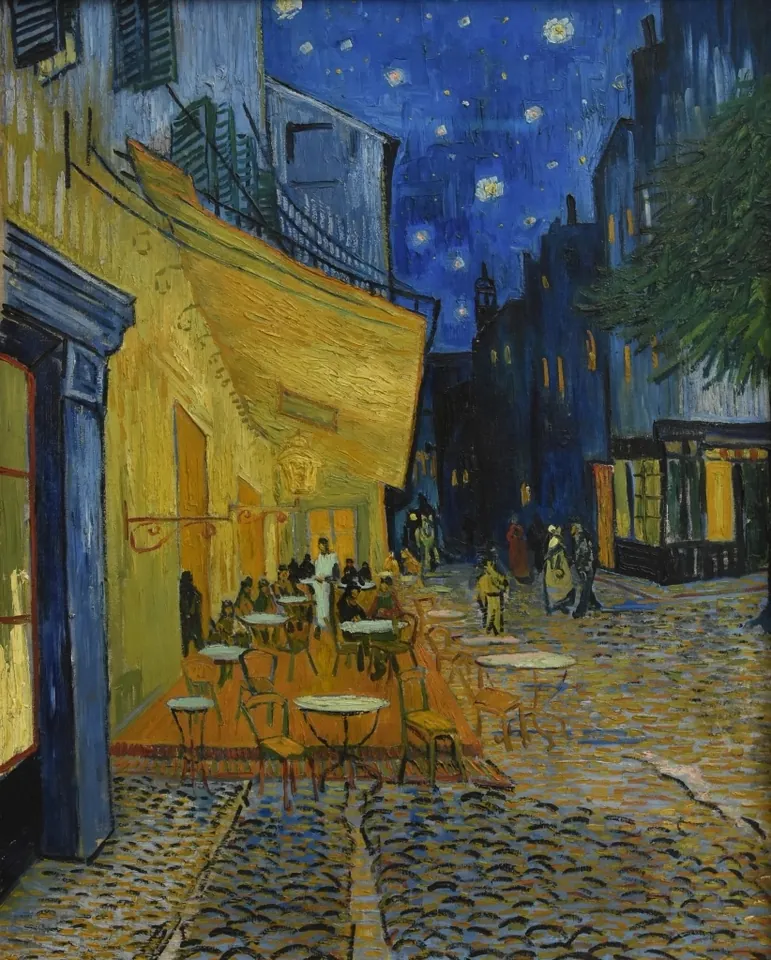
The last work is Van Gogh's Café Terrace at Night. It is well known that Van Gogh was emotionally very unstable, so many people regard him as a mad genius. This painting depicts a romanticized night in Arles, France, as Van Gogh saw it. Alone beneath the quiet sky, he painted this work without using any black, building it instead from various other colors. Van Gogh, a mad artist surrounded by cold air and faint artificial light in the dark of night, created a utopian world that belonged only to him. Through his eyes, stars light-years away illuminate a world that appears completely dark to ordinary people. He breaks it down into mysterious blue and purple, and glittering white and yellow clusters of stars, filled with imagination and hope.
The world Van Gogh saw was always transformed by the soul and the mind in this way. People, like nature, are always changing, so why must we associate night and cold with loneliness and sadness? Perhaps, perhaps, if we let the soul leap, night need never be surrounded by black.